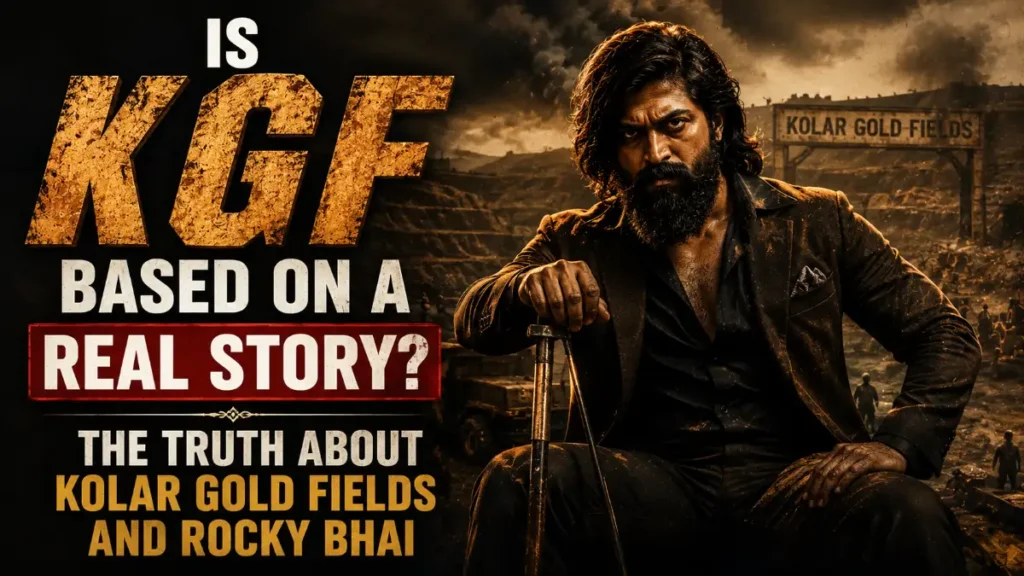

No, KGF is not based on a documented true story, and the fictional gangster Rocky Bhai never actually existed. However, the film’s setting, the Kolar Gold Fields, is a genuine historical location with a real, fascinating 121-year mining history, and the character of Rocky has repeatedly been linked in public speculation to a real Karnataka criminal named Thangam, a connection director Prashanth Neel has firmly denied.
This makes KGF a classic case of a film using a real, evocative location and vague “true story” marketing to create dramatic weight around what is, according to its own director, an entirely fictional narrative.
Quick answer: Kolar Gold Fields is a real gold-mining region in Karnataka with over a century of documented history. Rocky Bhai, his rise to power, and the criminal empire depicted in the film are fictional creations, not a real historical account.
Quick Answer Table
| Question | Answer |
|---|---|
| Is KGF based on a true story? | No, the plot and characters are fictional despite marketing claims |
| Is Kolar Gold Fields a real place? | Yes, it is a genuine gold-mining region in Karnataka with a documented history spanning over a century |
| Is Rocky Bhai a real person? | No, according to director Prashanth Neel, he is a fictional character |
| Is Rocky based on the criminal Thangam? | The director has denied it, though many reports and Thangam’s family have claimed similarities |
| Did Kolar Gold Fields really shut down? | Yes, the mines were closed in 2001 due to declining gold reserves and rising costs |
| Who directed KGF? | Prashanth Neel |
| Is there any mythological inspiration behind the story? | Yes, Neel has said the story draws heavily from the Mahabharata |
What Is KGF About?
KGF follows Rocky, a poor young man from the slums who rises through Mumbai’s criminal underworld with a singular, deeply personal motivation: fulfilling a deathbed promise to his mother to make her die as a wealthy woman rather than in poverty.
His journey eventually leads him to the Kolar Gold Fields, a brutal, exploitative gold-mining empire controlled by a violent, dynastic criminal family that treats thousands of mine workers as virtual slaves. Rocky is sent to KGF under the guise of assassinating the mine’s ruthless owner, but instead ends up staging a violent takeover, eventually becoming the mine’s new, feared ruler, a legend known across the underworld simply as “Rocky Bhai.”
The film’s second chapter continues this saga, following Rocky’s efforts to maintain control over KGF against rival criminal factions and a determined government crackdown, all set against a backdrop of exaggerated action sequences and larger-than-life storytelling that borrows heavily from mythological and epic narrative structures.
Is Kolar Gold Fields a Real Place?
Yes, and unlike the film’s central plot, this part of the story is entirely factual and remarkably well-documented. Kolar Gold Fields is a genuine region located in the Kolar district of Karnataka, approximately 90 to 100 kilometers from Bengaluru, and it holds a significant place in India’s colonial and industrial history.
According to historical records, gold extraction in this region dates back centuries, with references suggesting people extracted gold by hand as far back as the Chola Empire. The modern mining history began taking shape after 1799, following the death of Tipu Sultan in the Battle of Srirangapatna, when the British took control of surveying rights in the region while handing administrative responsibility to the princely state of Mysore.
Lieutenant John Warren of the British Government documented this early history, noting that villagers had long extracted gold from the area using hand-digging methods. Warren attempted to organize formal excavation by hiring local villagers, but his efforts ultimately proved unsuccessful, and the extraction plan was shelved.
How Modern Mining at KGF Actually Began
The real turning point for Kolar Gold Fields came in 1871, when Michael Fitzgerald Levally, a British soldier originally from New Zealand who had settled in Bangalore, read Warren’s account of the region’s gold deposits. Fascinated by the prospects, Levally obtained formal permission for excavation from the Maharaja of Mysore in 1873, and mining operations officially resumed in 1875.
This is where KGF’s real history becomes genuinely remarkable, and arguably more impressive than the film’s fictional narrative. The mining operations at Kolar required lighting for workers operating underground, and existing lanterns and torches proved insufficient for the scale of the work. This practical necessity led to India’s first power-generation units being built in 1889 specifically to support mining operations at KGF, making this obscure gold-mining town the first region in India to have active electricity, years before most major Indian cities.
By 1902, the mine employed approximately 30,000 workers and had adopted advanced extraction technology that reportedly recovered around 95 percent of the available gold. Over its operational lifetime spanning roughly 121 years, the mines at Kolar are estimated to have produced around 900 tonnes of gold.
Why Did Kolar Gold Fields Shut Down?
Despite its extraordinary productivity and historical significance, Kolar Gold Fields eventually became commercially unviable. As gold deposits at accessible depths were exhausted, mining operations had to go progressively deeper underground, dramatically increasing operational costs while gold prices simultaneously declined in global markets.
This combination of rising costs and falling profitability led the Indian government to officially shut down the mines on 28 February 2001, despite massive protests from workers and local communities who depended on the mining economy for their livelihoods. Interestingly, the mine complex also had a notable scientific legacy beyond gold extraction, having hosted particle physics experiments between the 1960s and 1992, taking advantage of its deep underground shafts to shield sensitive equipment from cosmic radiation interference.
Is Rocky Bhai Based on a Real Criminal Named Thangam?
This is where the “true story” debate around KGF becomes genuinely contentious, mirroring the kind of controversy seen in other major Indian films that blur the line between fiction and real-life inspiration.
According to multiple reports, the KGF franchise has long been rumored to be based on the life of Thangam, a notorious real criminal figure from Karnataka who reportedly worked at the Kolar Gold Mines and eventually formed his own criminal gang before being shot dead in a police encounter in 1997. Some reports suggest striking similarities between Rocky’s on-screen rise to power and Thangam’s real documented history within the same mining region.
This connection became serious enough that Thangam’s mother publicly threatened legal action against the makers of KGF: Chapter 2, and the production team behind a separate film specifically about Thangam’s life, reportedly titled Kolar, directly confronted director Prashanth Neel over the matter. According to Neel’s own account of the exchange, the makers of that competing project told him they held rights to Thangam’s story and warned him against making anything related to Thangam’s real life.
What Did Prashanth Neel Say About the Thangam Connection?
Director Prashanth Neel has consistently and firmly denied any direct connection between Rocky Bhai and Thangam. In an interview, he stated that he promised the makers of the Thangam-based project that there was nothing based on Thangam in his film, and went further to claim that he did not even know the specifics of Thangam’s real-life story at the time.
This creates a genuinely confusing situation for anyone trying to determine the truth: the film’s own promotional poster claimed KGF was “based on a true story,” yet the director has denied knowledge of the one real criminal figure most commonly associated with the plot, without ever clarifying what alternative true story the marketing claim might actually be referring to.
Based on available evidence, the most reasonable conclusion many film analysts and journalists have reached is that KGF likely drew loose, possibly unconscious thematic inspiration from real criminal folklore surrounding the Kolar mining region, including stories about figures like Thangam, without being a direct, deliberate retelling of any single documented life story.
The Mahabharata Connection: A Different Kind of “True Story”
Interestingly, while denying any specific real-life criminal inspiration, Prashanth Neel has openly discussed a completely different kind of source material shaping the film’s narrative structure: the ancient Indian epic, the Mahabharata.
According to Neel, the powerful, dynastic gangster family controlling the Kolar Gold Fields in the film is structured to mirror the Kuru family from the Mahabharata, with the elderly patriarch character resembling figures like Dhritarashtra or Bhishma. Rocky’s own character arc, as an outsider who enters an ongoing family feud and eventually emerges as its central hero, is described by Neel as being directly modeled on Karna, one of the most complex and tragic figures in the entire epic.
This mythological framing offers a genuinely interesting alternative lens for understanding the film’s “true story” claims: rather than being rooted in modern criminal history, KGF‘s emotional and structural DNA may be more accurately traced back to one of India’s oldest storytelling traditions, reimagined within a 20th-century industrial gold-mining setting.
Did the Filmmakers Ever Officially Clarify the “True Story” Claim?
Yes, at least partially. Multiple entertainment reports covering the film’s release noted that while its marketing leaned into “based on a true story” language, the filmmakers themselves have openly admitted the movie is a work of fantasy rather than a historical account. This acknowledgment directly contradicts the poster’s bold claim, creating the same kind of gap between marketing and reality seen in several other major Indian films that use vague true-story framing to heighten dramatic weight.
Why the Ambiguity Persists
The confusion surrounding KGF‘s true-story status persists for several understandable reasons. The setting is undeniably real and historically rich, giving the fiction a strong foundation of authenticity. The criminal folklore surrounding the actual Kolar mining region, including real figures like Thangam, provides just enough surface-level similarity to fuel ongoing speculation. And the filmmakers themselves have offered inconsistent messaging, denying specific real-life connections while never fully clarifying what, if anything, the original “true story” marketing claim was actually referring to.
The Most Accurate Way to Describe KGF
Given everything publicly available, the most accurate description is:
KGF is a fictional action drama set against the backdrop of the real, historically significant Kolar Gold Fields mining region in Karnataka, with a plot structurally inspired by the Mahabharata and a lead character, Rocky Bhai, who despite persistent public speculation linking him to real criminal Thangam, has been described by the director as an entirely fictional creation.