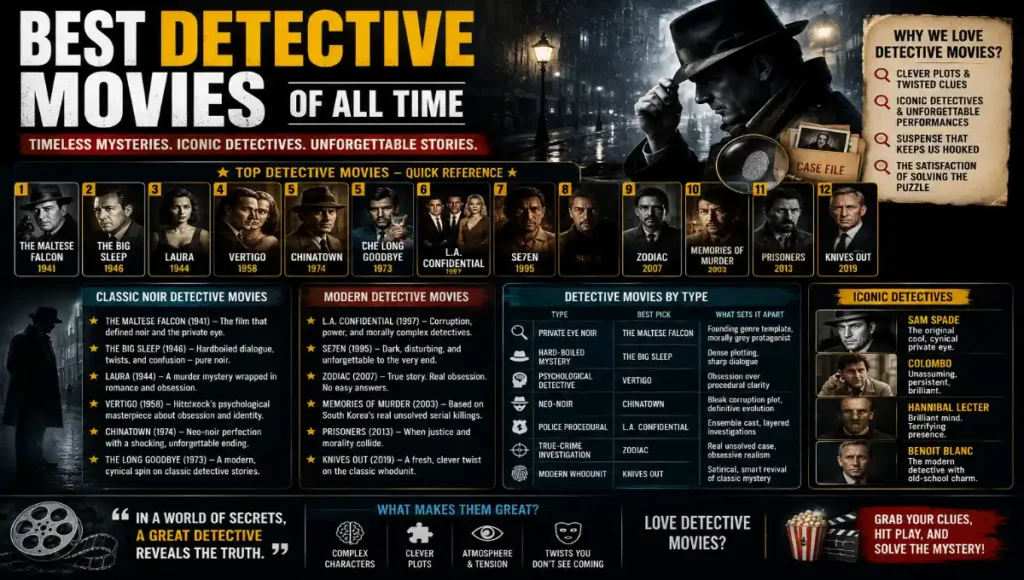

Detective movies have captivated audiences for generations by blending mystery, psychological tension, and the satisfaction of a puzzle solved, spanning everything from 1940s film noir to modern crime thrillers. This guide ranks the essential detective movies across classic noir, hardboiled investigations, and contemporary mystery-driven storytelling.
Quick Reference: Top Detective Movies
| Title | Year | Detective Type | Why It’s Essential |
| The Maltese Falcon | 1941 | Private eye | Founding film noir detective classic |
| The Big Sleep | 1946 | Private eye | Definitive hardboiled noir mystery |
| Laura | 1944 | Police detective | Atmospheric noir with romantic obsession |
| Vertigo | 1958 | Private investigator | Hitchcock’s psychological detective thriller |
| Chinatown | 1974 | Private eye | Neo-noir masterpiece with corruption plot |
| The Long Goodbye | 1973 | Private eye | Revisionist take on hardboiled detective genre |
| L.A. Confidential | 1997 | Police detectives | Ensemble corruption-era police procedural |
| Se7en | 1995 | Police detectives | Bleak modern detective thriller |
| Zodiac | 2007 | Police + journalist | True-crime obsessive investigation |
| Memories of Murder | 2003 | Police detectives | Korean procedural based on real case |
| Prisoners | 2013 | Police detective | Morally complex modern investigation |
| Knives Out | 2019 | Private investigator | Modern whodunit revival |
Classic Noir Detective Movies
Film noir gave the detective genre its visual language and moral ambiguity, establishing tropes that persist to this day.
The Maltese Falcon (1941)
Humphrey Bogart stars as private eye Sam Spade, entangled in a web of deception involving a priceless statuette and a cast of untrustworthy clients. Often cited as the film that launched the noir detective genre, its shadowy cinematography and morally grey protagonist became the template for decades of private-eye films that followed.
The Big Sleep (1946)
Bogart returns as Raymond Chandler’s iconic detective Philip Marlowe, navigating a plot so convoluted that even the filmmakers reportedly couldn’t fully explain it. What makes it essential isn’t the mystery’s clarity but its atmosphere – sharp dialogue, moral corruption, and a sense that every character is hiding something.
Laura (1944)
A police detective investigating a young woman’s murder becomes obsessed with her portrait and the idea of her, only for the case to take an unexpected turn. Its blend of romantic fixation and noir mystery gives it a psychological dimension that separates it from more straightforward whodunits of the era.
Vertigo (1958)
Alfred Hitchcock’s psychological thriller follows a retired detective hired to follow a friend’s wife, only to become dangerously obsessed with her. It reshaped what a detective story could explore emotionally, trading procedural clarity for obsession, guilt, and identity – themes that still influence modern mystery films.
Chinatown (1974)
Jack Nicholson plays private investigator J.J. Gittes, whose seemingly simple infidelity case unravels into a conspiracy involving water rights and family secrets in 1930s Los Angeles. Widely regarded as the definitive neo-noir, its bleak ending and layered corruption plot elevated the detective genre into serious dramatic territory.
The Long Goodbye (1973)
Robert Altman’s revisionist take on Philip Marlowe drops the classic hardboiled detective into 1970s Los Angeles, creating a deliberately anachronistic, morally hazy mystery. Its loose, improvisational style challenged noir conventions while still honoring the genre’s cynical core.
Modern Detective Movies Worth Watching
Contemporary detective films shifted toward psychological complexity, true-crime authenticity, and ensemble-driven procedurals.
L.A. Confidential (1997)
Set in 1950s Los Angeles, this ensemble film follows three detectives with different methods and motives as they uncover corruption tied to a multiple homicide. Its layered plotting and morally compromised characters make it one of the most acclaimed modern additions to the noir-influenced detective genre.
Se7en (1995)
Two detectives, one weary and one idealistic, track a killer staging murders around the seven deadly sins. Its relentlessly bleak tone and shocking conclusion redefined what a modern detective thriller could get away with, influencing countless films that followed.
Zodiac (2007)
David Fincher’s meticulous true-crime film follows police detectives and a newspaper cartoonist obsessively investigating the real unsolved Zodiac Killer case. Its focus on the psychological toll of an investigation without resolution makes it one of the most acclaimed detective-adjacent films of the 21st century.
Memories of Murder (2003)
This Korean procedural follows detectives investigating the country’s first documented serial killings, based on a real case that remained unsolved for decades. Its blend of dark comedy and mounting frustration over an elusive killer offers a distinctly different tone from Western detective procedurals.
Prisoners (2013)
Detective Loki investigates a child abduction case while a desperate father takes matters into his own hands, creating tension between procedural justice and vigilante morality. Its refusal to offer easy answers makes it a standout modern entry in the detective genre.
Knives Out (2019)
Detective Benoit Blanc investigates a wealthy patriarch’s death, reviving the classic whodunit format with sharp wit and a satirical edge. Its success proved audiences still crave clever, puzzle-driven detective stories when executed with genre-savvy style.
Detective Movies by Type
| Detective Type | Best Pick | What Sets It Apart |
| Private eye noir | The Maltese Falcon | Founding genre template, morally grey protagonist |
| Hardboiled mystery | The Big Sleep | Dense plotting, sharp dialogue |
| Psychological detective | Vertigo | Obsession over procedural clarity |
| Neo-noir | Chinatown | Bleak corruption plot, definitive genre evolution |
| Ensemble police procedural | L.A. Confidential | Multiple detective perspectives, layered corruption |
| True-crime investigation | Zodiac | Real unsolved case, obsessive realism |
| Modern whodunit | Knives Out | Satirical revival of classic mystery format |
Why Detective Movies Endure
The detective genre has survived nearly a century of cinema because it taps into a universal satisfaction: watching order restored to chaos through careful reasoning and persistence. What separates the best entries – from The Maltese Falcon to Zodiac – is their willingness to complicate that satisfaction, whether through moral ambiguity, unresolved mysteries, or characters whose obsession costs them as much as it reveals. This tension between resolution and unease is why the genre keeps reinventing itself, from 1940s noir to Korean procedurals to modern whodunit revivals like Knives Out.
Frequently Asked Questions
What is considered the greatest detective movie of all time?
The Maltese Falcon and Chinatown are most frequently cited as genre-defining classics, given their lasting influence on how detective stories are structured and filmed.
What’s the difference between a detective movie and a crime thriller?
Detective movies center specifically on an investigator figure solving a mystery through deduction, while crime thrillers can focus more broadly on criminals, heists, or general suspense without a dedicated detective protagonist.
Are any detective movies based on real cases?
Yes, Zodiac and Memories of Murder are both based on real, documented unsolved cases, adding a layer of authenticity that fictional detective stories don’t have.
What makes film noir detective movies different from modern ones?
Film noir detective movies rely on stylized shadow-heavy cinematography, cynical narration, and morally compromised protagonists, while modern detective films often favor psychological realism or ensemble procedural structures.
Is Knives Out considered a true detective movie?
Yes, Knives Out revives the classic whodunit format with Detective Benoit Blanc as a modern take on the puzzle-solving investigator, honoring genre conventions while adding contemporary wit.