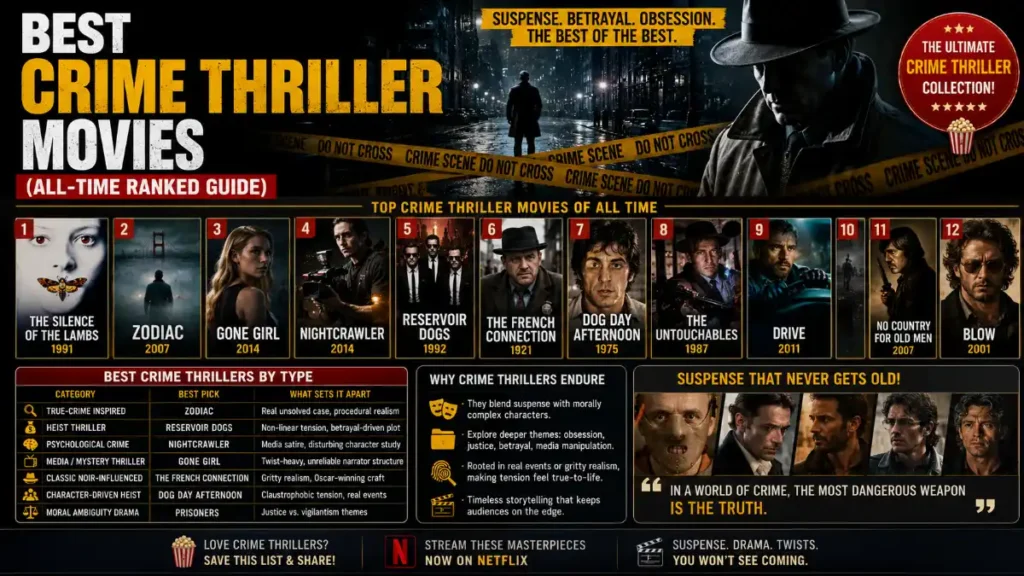

Crime thrillers are one of cinema’s most enduring genres, blending suspense, moral complexity, and morally grey characters into stories that keep audiences hooked from the opening scene. This guide ranks the best crime thriller movies of all time, drawing on the genre’s evolution from classic noir to modern true-crime-inspired storytelling.
Quick Reference: Top Crime Thriller Movies
| Title | Year | Director | Why It’s Essential |
| The Silence of the Lambs | 1991 | Jonathan Demme | Genre-defining psychological crime thriller |
| Zodiac | 2007 | David Fincher | True-crime obsession and cerebral tension |
| Gone Girl | 2014 | David Fincher | Twist-driven marriage-turned-crime story |
| Nightcrawler | 2014 | Dan Gilroy | Satirical crime thriller on media exploitation |
| Reservoir Dogs | 1992 | Quentin Tarantino | Genre-defining heist-aftermath thriller |
| The French Connection | 1971 | William Friedkin | Five-time Oscar-winning neo-noir classic |
| Dog Day Afternoon | 1975 | Sidney Lumet | Claustrophobic, character-driven bank heist |
| The Untouchables | 1987 | Brian De Palma | Prohibition-era crime drama with real stakes |
| Drive | 2011 | Nicolas Winding Refn | Stylish, minimalist getaway-driver thriller |
| Prisoners | 2013 | Denis Villeneuve | Morally complex investigation into justice |
| No Country for Old Men | 2007 | Coen Brothers | Oscar-winning bleak crime thriller |
| Blow | 2001 | Ted Demme | Real-life drug trafficking cautionary tale |
Classic Crime Thrillers That Defined the Genre
Long before modern true-crime obsession took over streaming, a handful of films set the template for what a crime thriller could be.
Rope (1948)
Alfred Hitchcock’s experimental thriller follows two men who strangle a former classmate and then host a dinner party to prove their intellectual superiority. Its real-time structure and single-location setup make it a masterclass in psychological tension, exploring guilt and voyeurism with unusual restraint for its era.
The French Connection (1971)
This neo-noir classic follows two NYPD detectives chasing a heroin smuggling ring based in Marseille. Winning five Academy Awards including Best Picture, it’s praised for its gritty realism and one of cinema’s most celebrated car chase sequences, cementing itself as a foundational crime thriller.
Dog Day Afternoon (1975)
Al Pacino stars as Sonny, an amateur bank robber whose heist spirals into a media circus. Sidney Lumet’s direction creates a suffocating, anxiety-inducing atmosphere that transcends typical genre conventions, delivering one of the most memorable character studies in crime cinema.
The Untouchables (1987)
Set during Prohibition, this Brian De Palma film follows Treasury agent Eliot Ness as he assembles a team to bring down Al Capone. Rooted in real events and elevated by David Mamet’s script, it set a high standard for blending intense action with dramatic tension.
Reservoir Dogs (1992)
Quentin Tarantino’s genre-defining debut follows the paranoid aftermath of a jewelry heist gone wrong, as surviving criminals suspect a police informant among them. Its razor-sharp dialogue and non-linear structure revolutionized independent filmmaking and remains a benchmark for loyalty-and-betrayal crime stories.
Modern Crime Thrillers Worth Watching
The genre evolved significantly after 2000, blending suspense with deeper character studies and moral ambiguity.
Zodiac (2007)
David Fincher’s meticulous true-crime thriller chronicles the decades-long hunt for the Zodiac Killer in the San Francisco Bay Area. Rather than focusing on violence, it emphasizes obsession and the psychological toll of an unsolved mystery, making it one of the most acclaimed crime thrillers of the 21st century.
Nightcrawler (2014)
Jake Gyllenhaal plays a con man who muscles his way into L.A.’s crime journalism scene, blurring the line between observer and participant. This Oscar-nominated thriller satirizes media exploitation while delivering one of the most unsettling character transformations in recent crime cinema.
Gone Girl (2014)
Fincher’s adaptation of Gillian Flynn’s novel follows a deteriorating marriage that turns into a media-fueled crime mystery after a wife’s disappearance. Rosamund Pike’s performance as the morally complex Amy Dunne anchors this twist-heavy thriller as both a genre standout and a critique of media manipulation.
Drive (2011)
Nicolas Winding Refn’s stylish thriller follows an unnamed Hollywood stuntman moonlighting as a getaway driver who gets pulled into a dangerous heist. Ryan Gosling’s minimal dialogue and the film’s striking visual direction make it a modern crime thriller that works as both action and character study.
Prisoners (2013)
Denis Villeneuve’s Oscar-nominated film follows a desperate father who takes a child-abduction investigation into his own hands. It refuses easy answers, instead forcing audiences to confront questions of justice, vigilantism, and moral compromise, making it a benchmark for modern crime cinema.
Best Crime Thriller Movies by Type
| Category | Best Pick | What Sets It Apart |
| True-crime inspired | Zodiac | Real unsolved case, procedural realism |
| Heist thriller | Reservoir Dogs | Non-linear tension, betrayal-driven plot |
| Psychological crime | Nightcrawler | Media satire wrapped in disturbing character study |
| Media/mystery thriller | Gone Girl | Twist-heavy, unreliable narrator structure |
| Classic noir-influenced | The French Connection | Gritty realism, Oscar-winning craft |
| Character-driven heist | Dog Day Afternoon | Claustrophobic tension, real events |
| Moral ambiguity drama | Prisoners | Justice vs. vigilantism themes |
Why Crime Thrillers Endure
The crime thriller genre traces back to golden-age film noir and has continuously evolved without losing its core appeal – suspenseful narratives paired with morally complex characters. What separates the best entries from generic genre fare is their willingness to explore deeper themes: media manipulation in Gone Girl and Nightcrawler, justice and vigilantism in Prisoners, and obsession in Zodiac. This thematic depth, combined with technical craft from directors like Fincher, Tarantino, and Hitchcock, is why these films remain reference points for the genre decades after release.
Frequently Asked Questions
What is considered the greatest crime thriller of all time?
Critics and rankings frequently cite The Silence of the Lambs, Zodiac, and The French Connection among the greatest, given their genre-defining craft and lasting cultural influence.
What’s the difference between a crime thriller and a crime drama?
Crime thrillers emphasize suspense and tension-driven plotting, while crime dramas focus more on character development and moral consequences without necessarily building toward a suspenseful climax.
Are crime thrillers based on true stories more popular?
True-crime-inspired thrillers like Zodiac and Blow tend to resonate strongly with audiences because the added layer of authenticity makes the tension feel more grounded and haunting.
What makes Reservoir Dogs a genre-defining crime thriller?
Its non-linear storytelling, sharp dialogue, and focus on betrayal among criminals revolutionized independent filmmaking and set a new standard for heist-aftermath narratives.
Is Gone Girl considered a crime thriller or a psychological thriller?
It functions as both — the missing-persons investigation drives the crime plot, while Amy Dunne’s manipulation and the media frenzy give it strong psychological thriller elements.